The Shape of Sukumar
Kurt Vonnegut once said something simple and brilliant: every story has a shape, and you can draw it. Put time along the bottom of a chart, from the opening scene to the credits. Put "how well things are going for the hero" up the side — top is wonderful, bottom is awful. Now trace the line. A feel-good film rises. A tragedy slides down. A thriller plunges into a pit and crawls out.
We wondered: if a single film has a shape, does a whole career have one? So we took eight films by the Telugu director Sukumar — from his 2004 debut to 2024's Pushpa 2 — and drew the line for each. Then we lined them up, oldest to newest, to see how his storytelling changed over twenty years.
The short answer: his heroes grew up, and then they took over.
How we "drew" each film
We didn't watch the films by hand. We had a computer read each film's English subtitles from beginning to end — all the dialogue, in order — the way a careful viewer follows a story. As it read, it kept running notes (who the hero is, what they want, how it's going) and, at twenty points across the film, it rated thirteen simple things: how well the hero is doing, how tense the moment is, how much is at stake, whether the problem is getting solved, how much control the hero has, and so on.
The most important of those is fortune — plain old "is life going well for the hero right now." Chart it across the film and you get the story's shape. (The green line below is resolution — are things getting settled — and the pale line is tension.)
One honest note up front: subtitles are words, not pictures. The computer hears what characters say, not the silent action, the fights, or the songs. And the scores are rough. So read these as a sketch of each film's shape, not a verdict on the film.
Twenty years, one direction
Here's the whole career on one chart. Each dot is a film, in order of release. The gold line is how much control the hero has by the end — are they running things, or at the mercy of the world? The orange line is whether the hero ends up better or worse than they started.
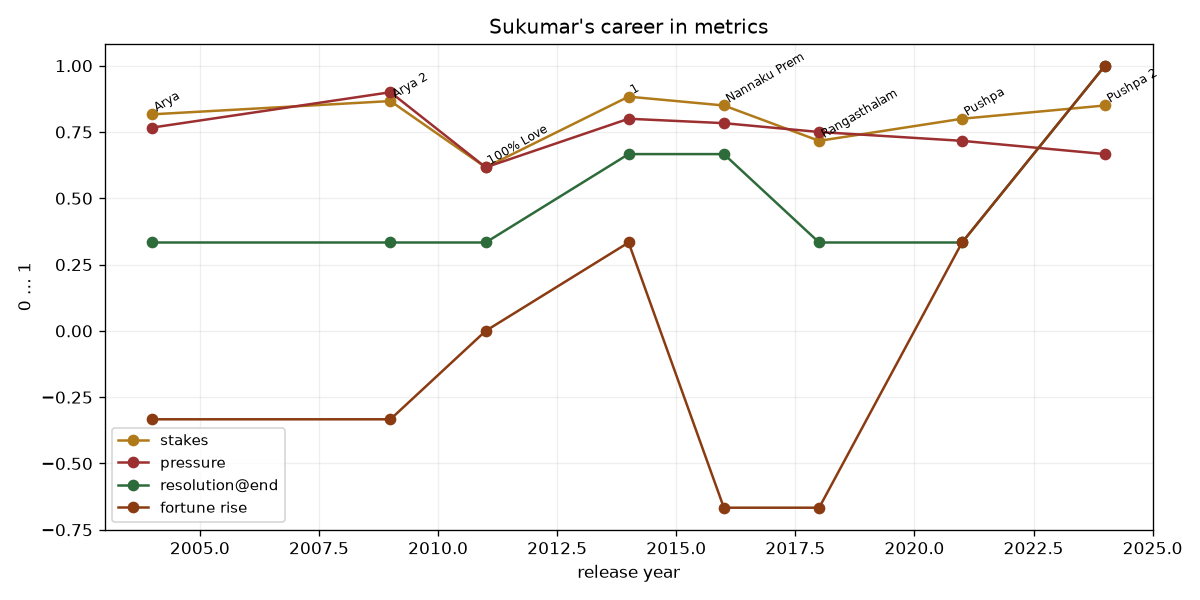
Both lines climb. In the early films the hero ends with little control and often worse off than they began. By the Pushpa films the hero ends fully in charge and far better off. Here are the heroes' fortune lines again, colored by era — the early films (green) tend to sag and fall; the recent films (red) rise and soar:
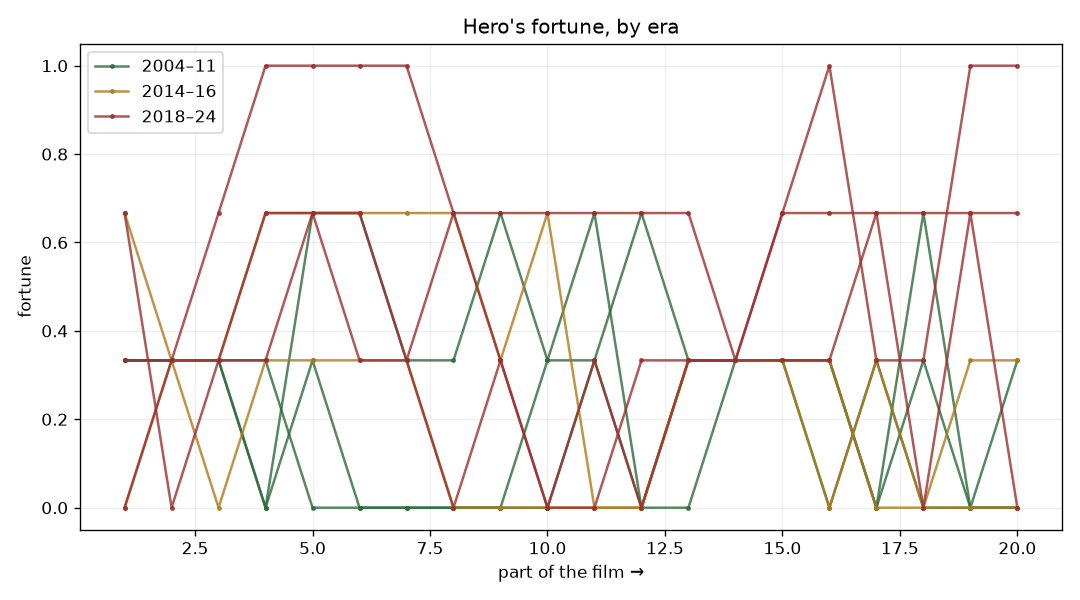
In plain terms: Sukumar started out telling stories about underdogs who don't quite win — and grew into telling stories about outsiders who end up ruling everything. The turning point is the Pushpa era.
Film by film
2004 · Arya
a college romance built on one-sided devotion. (134 minutes)
Shape: Oedipus — hope that keeps collapsing. The line sits low and ends lower. For all his effort, the hero finishes with little in hand — a love story shaped like a quiet defeat.
2009 · Arya 2
a darker, more unsettling take on love and friendship. (158 minutes)
Shape: Oedipus — hope that keeps collapsing. The same falling shape, pushed harder: the most high-pressure of the early films, and again the hero ends with almost nothing.
2011 · 100% Love
two cousins, pride, and a romance that keeps score. (138 minutes)
Shape: Icarus — flies high — then the fall. A flat line that never really lifts. The tension stays low; ego, not danger, drives it. A romance that stays level and lands about where it began.
2014 · 1: Nenokkadine
a rock star who can't trust his own memory — a psychological thriller. (171 minutes)
Shape: Man in a hole — down into trouble, then back out. The first real turn in his work: the hero starts in doubt, dips into a hole, climbs out — and the story actually resolves. Things get sorted.
2016 · Nannaku Prematho
a son's elaborate plan to undo the ruin of his father. (149 minutes)
Shape: Fall — a long slide down — a tragedy. A clean tragedy shape. Fortune starts high and falls all the way to the floor — a long game played out to a hard, costly end.
2018 · Rangasthalam
a period village drama about a partly-deaf man against a rigged system. (171 minutes)
Shape: Man in a hole — down into trouble, then back out. The village darkens through the middle, pressure building, before it turns. The hero ends more in control, even as the world around him stays grim.
2021 · Pushpa: The Rise
a daily-wage labourer climbing the red-sanders smuggling trade. (172 minutes)
Shape: Rise — a steady climb — rags to riches. For the first time, the hero ends on top. The line climbs, and by the finish he is fully in command — an outsider who takes charge.
2024 · Pushpa 2: The Rule
the smuggler, now a power, holding and extending his rule. (197 minutes)
Shape: Cinderella — up, a hard knock, then soaring. The purest climb of them all. Fortune goes from the floor to the ceiling, and the hero ends in total control. Rags to rule.
What actually changed
Lining the eight films up by year, a few things move together (eight films is a small sample, so take these as the direction of travel, not hard science):
| Over the twenty years… | early films | recent films |
|---|---|---|
| Does the hero end in control? | barely (≈0.1) | almost fully (≈0.9) |
| Does the hero end better than they started? | usually worse | usually better |
| Do the problems get resolved by the end? | often left hanging | mostly settled |
| How tense / anxious is the telling? | higher | a little lower |
The clearest signal is control. Sukumar's early heroes are swept along — by love, by obsession, by fate. His recent heroes seize the wheel and don't let go. The stories also resolve more cleanly now: the early films can end on a question mark or a loss, while Pushpa 2 ends about as high and settled as a story can.
See it move
Here's the whole thing as a short film — each shape drawing itself in, then the career trend, set to music:
The fine print
This is one computer's reading of eight films, from subtitles, on a rough scale. It misses everything that isn't spoken — the visual grandeur, the action, the songs that carry so much of these films. One film, Jagadam (2007), isn't here at all, because we couldn't find English subtitles for it. And "a career has a shape" is a fun idea, not a theorem. But the trend is clear enough to feel true if you've watched these films: the man who once drew quiet defeats now draws triumphant rises.
Made with the same "shape of a story" reader described in our earlier post. All the charts are our own data; no film footage, images or dialogue are used.