Translation From Scratch · Part 7
Getting the words right, and why polishing didn't help
Part 6 ended on an optimistic note: the structure was learnable, the vocabulary was handled, and what remained looked like a word-order problem. Then I typed a sentence into the demo that a real person would type.
Can you drop me at the airport.
क्या आप मुझे एयरपोर्ट पर गिरावट हैं?
गिरावट is "a drop" — as in a drop in share prices. The sentence asks whether you are a decline at the airport. The order is fine. The postposition is fine. The word is wrong, and the verb is a bare है. This post is about the two problems hiding in that one line — word sense and tense — and about an idea that should have fixed fluency and didn't, which turned out to be the most informative failure of the whole project.
Problem one: the skeleton threw the tense away
The verb first. I went looking and found something embarrassing: announced, announces and will announce all produced the same Hindi verb, किया. The structure model wasn't confused about tense. It had never been told. When the English sentence becomes a skeleton, every verb becomes V1 — and V1 has no tense. The Hindi side of the training data carried a tense tag on its slots (V1.mse = masculine, singular, perfective), so the model learned to emit tense — but with nothing on the source to condition on, it emitted the most common one: the news-corpus perfective.
The fix is one character. English verb slots now carry the English tense: V1.p (past), V1.r (present), V1.n (infinitive / future with will), and so on. Retrain, and the tenses separate: announced → perfective किया, announces → habitual करते हैं, the future lands on its own form. Verb-form accuracy (gender + number + tense) went from 0.366 to 0.387 — small, because most verbs in the corpus are past-tense news, but the behaviour is now right.
The general lesson took me longer to absorb than it should have: the skeleton is only as good as what it keeps. Everything the abstraction drops, the model has to guess. That lesson comes back, much bigger, in part 9.
Problem two: one dictionary entry per word
Now the word. The read-out looks up each English content word in a bilingual dictionary built from the word alignments, and that dictionary stores the most frequent Hindi translation. For drop, in a corpus of news, that's गिरावट. The right sense — छोड़ना, "to drop someone off" — was in the data. We had just thrown it away when we took the argmax.
So the first step was to stop throwing it away: a multi-sense dictionary, built from the same alignments, that keeps every Hindi lemma an English word was aligned to, with counts. For drop: गिरावट (5), बूंद "a droplet" (5), छोड़ना (4). About 5,500 English words have more than one real sense.
Then you need something that picks a sense from context. I tried two, and the difference between them is a neat illustration of why embeddings won:
- Collocations (a Naive-Bayes vote over the context words seen with each sense) are transparent — you can print the words that voted — and work for frequent senses. But airport never co-occurred with drop in training, so there was nothing to vote with.
- Nearest neighbours over contextual embeddings. The aligner is a fine-tuned multilingual BERT, so it already produces a context-dependent vector for every word occurrence. Store up to a couple of dozen occurrences of each ambiguous word (about 100k vectors in all), labelled with the sense the alignment gave them; at translation time, embed the new occurrence and see which sense's neighbours it lands near. Drop me at the airport lands among the occurrences where drop meant leaving someone somewhere, and छोड़ना wins.
Getting the kNN right took three fixes worth writing down, because each one is a general trap:
- Constrain the vote to the word's own sense list. Unconstrained, a neighbour from a different word can win, and the system cheerfully returns a Hindi word that isn't a translation of drop at all.
- Average the best few neighbours per sense; don't sum all of them. Summing lets the frequent sense win on sheer numbers, which is the bias we were trying to escape.
- Only override the default with a margin. If the best sense barely beats the majority sense, keep the majority sense.
With that, drop me at the airport became क्या आप मुझे एयरपोर्ट पर छोड़… — right sense, still rough verb form.
Looking inside: what the structure model attends to
At this point I wanted to see what the structure model was doing, so I pulled out its cross-attention: for each Hindi skeleton token it generates, how much it looks at each English skeleton token.
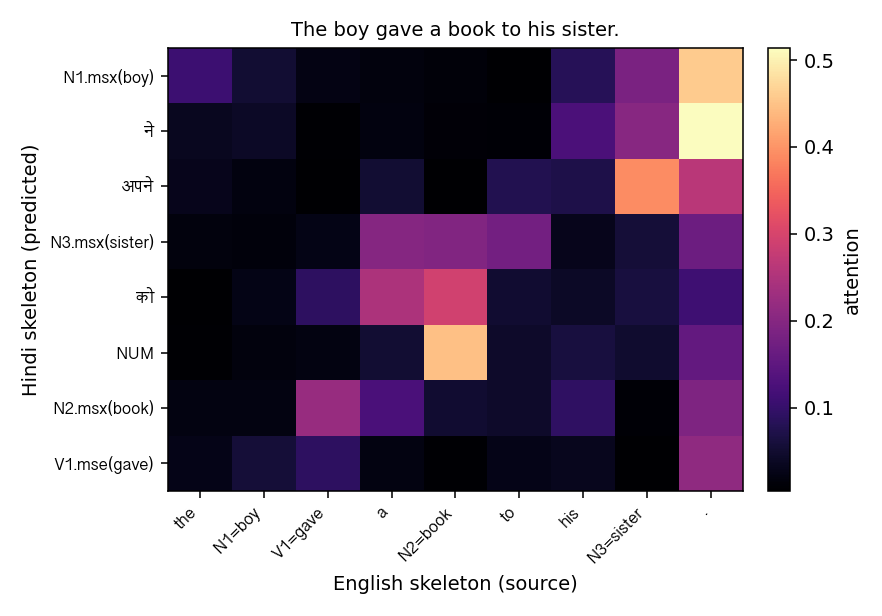
It is readable in places — अपने ("his own") looks at his and sister; को looks at the recipient region — and murky in others: a lot of attention sits on the final full stop, a common "sink" in small transformers, and some rows land one token to the side of where you'd expect. Attention maps are a flashlight, not a proof.
But look at the row label N3.msx(sister). The model marked sister — बहन, a feminine noun — as masculine. It had to: it never sees which Hindi word fills N3. It predicts the gender of a slot without knowing the word. Remember that row; it becomes the key to part 10.
The idea that should have fixed fluency
By now each sentence came out with roughly the right words in roughly the right order — and still read as broken Hindi. The natural idea (and a good one) was a smoother: a second, monolingual Hindi→Hindi seq2seq model that takes the mechanical read-out and polishes it into fluent Hindi. Keep the faithful, inspectable pipeline; bolt fluency on at the end.
Version 1 was trained on (read-out → reference Hindi) pairs. It was worse on everything: chrF 0.326 → 0.232, and 96% of its outputs changed the content of the sentence. The reason is obvious in hindsight. The references are loose human translations, so the model learned "rewrite this into something like a reference" — and it hallucinated toward them. No new taxes became no new programs. A content-diff guard caught it (it reverted 96% of the outputs), which made the smoother safe and useless.
Version 2 fixed the training signal: a denoising autoencoder. Take the reference Hindi, corrupt its grammar while keeping its content fixed — wrong inflection of the same word, dropped or duplicated function words, a dropped final auxiliary, a local swap — and train the model to restore it. Now the only thing it can learn is grammar. Content drift fell from 96% to 47% and faithfulness held. And fluency didn't move at all.
The judge that told me why
To score these smoothers honestly I needed something better than chrF (which lied before) and better than LaBSE (which only measures meaning). I used Jev, a calibrated judgment API from TypeSafe, which answers typed questions — yes/no probabilities and ordered scores — and asked it three separate things: is it faithful, how much of the meaning does it convey (0–3), how fluent is the Hindi (0–3).
| faithful | adequacy /3 | fluency /3 | |
|---|---|---|---|
| our read-out | 0.25 | 1.70 | 0.63 |
| smoother v1 | 0.09 | 0.99 | 0.54 |
| smoother v2 (denoising) | 0.23 | 1.57 | 0.64 |
| reference Hindi | 0.56 | 2.48 | 2.26 |
That table reframed the project. LaBSE had said we were at 96% of the reference's semantic score, and that was true — the meaning mostly got through. What LaBSE couldn't see was that our Hindi scored 0.63 out of 3 for fluency against the reference's 2.26. The gap was never adequacy. It was fluency, and it was huge. (Jev also caught the references being noisy: the reference itself was judged fully faithful only 56% of the time.)
And it explained the smoother. A denoiser can fix साइटें → साइट. It cannot invent a verb the read-out never produced, or put back a postposition the skeleton never contained. Our read-outs weren't slightly wrong Hindi with surface errors; they were missing pieces. Fluency lives upstream — in what the structure model is allowed to see and produce — not in post-processing.
I didn't yet know which pieces were missing, or why. Finding that out took a detour through someone else's translator, which is the next post.