ASR From Scratch · Part 7
Filling the gaps: borrow the data, or record it?
Last time I traced the recognizer's errors down to the specific sound-triples it was starved of in training, and turned that into a targeted recording script — a few hundred sentences that cover the gaps far faster than recording random text. Which raises the obvious, cheaper question before anyone touches a microphone: do we even need to record? Is this gap already sitting in some public dataset we could just download?
So I checked, and then worked out what recording would actually buy. The answer is a clean split: most of the gap is a domain accident that public data fixes for free, and a small residual is genuinely yours to record.
Are the gaps even English?
The gaps are rare triphones — sound-triples the model barely saw. The first thing to ask is whether they're rare because English rarely uses them, or just because LibriSpeech rarely uses them. LibriSpeech is read audiobooks, heavy on 19th-century prose; its rare units cluster in Victorian surnames (Bozzle, Trevelyan, Quilter). That's a corpus artifact, not a fact about English.
To test it, I took every gap triphone and asked whether it appears in any ordinary English word, using CMUdict's 123,000-word lexicon as a stand-in for "the language at large."
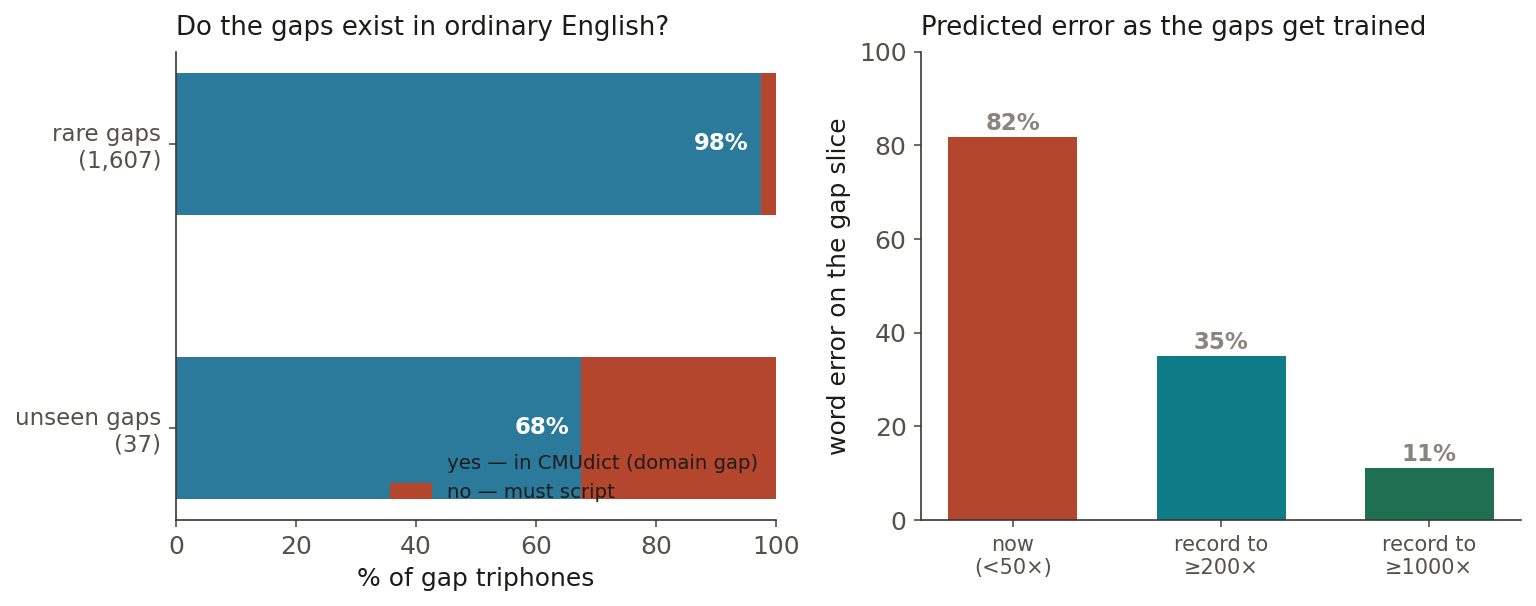
98% of the rare gap triphones, and 68% of the ones never seen in 460 hours, occur in everyday English words. The units the model fails on aren't exotic — ɔɪ ɹ ʌ lives in Moira, b æ z in basil and Baz, ɚ ɡ ɔɪ in Burgoyne. They're missing from LibriSpeech's books, not from the language. Which means a broader-domain corpus almost certainly contains them:
| Public English corpus | Domain | ~Hours |
|---|---|---|
LibriSpeech train-other-500 |
audiobooks (same as ours) | 500 |
| TED-LIUM 3 | conference talks | 452 |
| VoxPopuli (EN) | European Parliament | 1,800 |
| Common Voice (EN) | crowd-read sentences | thousands |
| GigaSpeech | audiobooks, podcasts, YouTube | 10,000 |
| People's Speech | broad, web-scraped | ~30,000 |
| Loquacious Set (2025) | several of the above, merged | 25,000 |
Scaling from our 460 hours into any of the big multi-domain sets — GigaSpeech, People's Speech, the combined Loquacious set — would pull the vast bulk of the rare-triphone tail above the frequency where it stops causing errors. For the general phonotactic gap, the cheapest fix is not a microphone; it's a bigger, more varied download. That's the honest first move.
Where borrowing stops working
But look at the right-hand tail of that check. Thirty-two percent of the never-seen triphones — and a stubborn ~40 of the rare ones — appear in no CMUdict word at all. And even the ones that do live almost entirely in proper names: places, surnames, loanwords. This is where public data quietly fails you, and it fails in a way that's easy to miss.
A bigger corpus has more names — but they're different names. GigaSpeech will teach the model Obama and Zelensky; it will not teach it Bozzle, and it certainly won't teach it whatever names matter in your deployment — your users, your streets, your product's vocabulary. Names are an open class; you cannot download your way to the ones you specifically need. This is exactly the residual the targeted recording script was built for: the sounds no natural pool sentence contains, which you have to script on purpose from words that realize them.
So the decision rule is simple. Borrow for the general tail; record for your names.
What recording buys, before you record
Because the errors are tied to training frequency by a measured curve, you can predict the payoff before collecting anything. The words sitting on gap triphones (rarest triple seen fewer than fifty times) are 1.5% of dev words and wrong 82% of the time. Push those triphones over ~200 training examples each and the curve says their error should fall to about 35%; over ~1000 examples, to about 11% — the same floor as common words.
Globally that's small — 1.5% of words moving from 82% to 11% shaves overall word-error from ~16.8% to ~15.7%. This is the honest part: filling the gaps does not move the headline WER much, because the gaps are rare by definition. What it does is turn specific hard words from almost always wrong into usually right — the names and rare terms a user actually notices getting mangled. If those words are load-bearing for your application, that per-word swing is the whole game; if they aren't, don't bother, and spend the effort elsewhere. The audit tells you which case you're in.
The loop, end to end
Here's the concrete procedure to record and confirm the gain, in this repo's terms:
- Freeze the target. Take the gap list (
gap_report.py) and the recording script (recording_script.py), plus a hand-written prompt set for the ~40 must-script triphones — pick real words that realize each (b æ z→ "Baz",s ɔɪ ɚ→ "Sawyer") and drop them into carrier sentences. - Borrow first. Fold a broad public set (GigaSpeech or Common Voice) into the manifest and re-measure coverage. Most of the rare tail closes here for free; whatever gap units remain under-supplied are your real recording list — usually a few hundred, dominated by names.
- Record deliberately. Several speakers (accent and pitch variety matter more than raw hours here), 16 kHz, quiet room. Aim for each target unit realized ≥200 times across speakers — the curve's usable knee — which for a few hundred units is on the order of a few hours, not hundreds.
- Prepare and retrain. Add the clips to the manifest, rebuild the per-utterance caches (
phase1features, true-unit codes), extend the BPE/lexicon so the new names are spellable, and continue-train the existing recognizer — every training script here is resumable (RESUME=1), so this is a fine-tune, not a restart. - Measure the right thing. Do not just watch overall WER — it barely moves. Build a targeted eval slice of dev/test utterances that contain the gap units and report error on that slice, before and after. That's where the 82% → 35% drop shows up, and it's the number that proves the collection worked. Global WER is the vanity metric; the slice is the honest one.
Why this is the payoff of the whole approach
This closes a loop the frozen-codebook idea was quietly built for. Because the units are discrete, legible phones, every step here is countable: the gap is a set of triphones, "is it in public data" is a lexicon lookup, the recording script is a set-cover, and the expected gain is read off a frequency curve. Data collection stops being "get more audio and hope" and becomes an audit with a bill attached — these units, from this source, for this predicted improvement on these words.
And it's the piece the Telugu port actually needs. The recipe transfers whole: build the phone recognizer, count the triphones, borrow what broad Indic corpora already cover, and reserve the microphone for the aksharas and names that nobody else has recorded — measuring success on the slice that contains them, not on an average that hides them.